> For the complete documentation index, see [llms.txt](https://help.onform.com/llms.txt). Markdown versions of documentation pages are available by appending `.md` to page URLs; this page is available as [Markdown](https://help.onform.com/account/sign-in-and-accounts/sign-in-methods-and-more-than-one-account.md).
# Sign-in methods and more than one account
Sign in with Apple, Google, Microsoft or an email code. A different method or email can create a second account: here's how to tell which one you're in.
Works on: iPhone, iPad, Android and web.
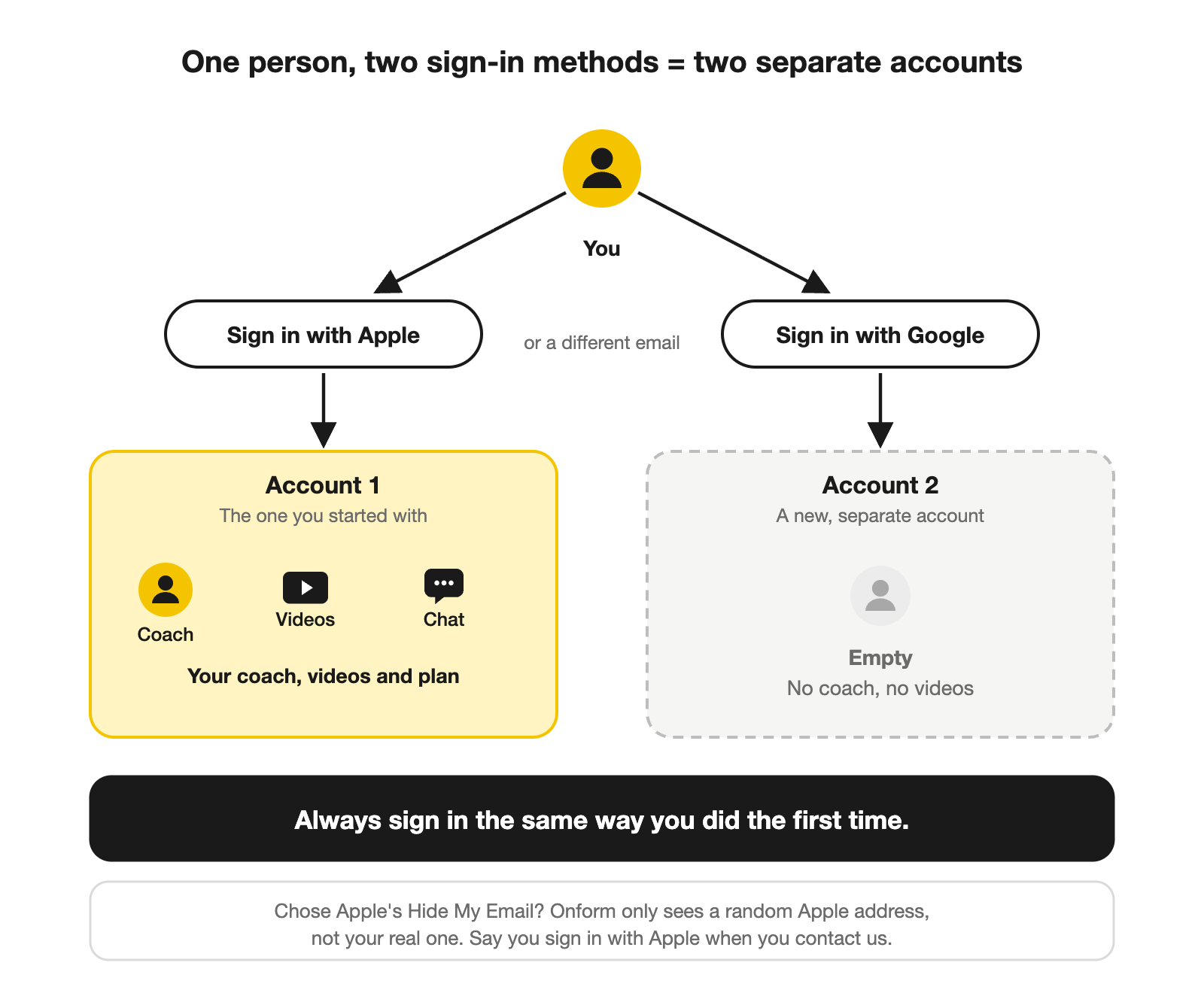
You can sign in to Onform four ways: with **Apple**, **Google**, **Microsoft**, or your **email** (we send you a 6-digit code, so there's no password). Each one opens the Onform account it was set up with. If you use a different method or email later, you can end up with a second, separate account, which looks like your coach, videos or plan have gone missing.
## Choose a sign-in method
All four methods work on iPhone, iPad, Android and the web app.
| Method | Good to know |
| --------- | ----------------------------------------------------------------------------------------------------------------------------------- |
| Apple | Quick on iPhone and iPad. If you choose **Hide My Email**, Onform gets a random Apple address instead of your real one (see below). |
| Google | Uses your Google account. There's no separate Onform password. |
| Microsoft | Handy for school or work Microsoft accounts. |
| Email | Type your email address and we send you a 6-digit sign-in code. Each code works once and expires after a short time. |
Pick the one you'll be able to use on **every** device for years. If your account is tied to a school or work email, think about whether you'll still have it after you leave.
## Sign in to an existing account
{% tabs %}
{% tab title="iPhone and iPad" %}
1. Open Onform and tap **Have An Account? Log In**.
2. Under the QR code, tap **Log In Another Way**.
3. Tap the method you used before: **Sign in with Apple**, **Sign in with Google**, **Sign in with Microsoft** or **Sign In With Email**.
If you've signed in on this device before, the screen may remind you which method and email you used last time.
{% endtab %}
{% tab title="Android and web" %}
1. Open Onform and tap **Have An Account? Log In**.
2. Under the QR code, tap **Log In Another Way**.
3. Tap the method you used before: **Sign In With Google**, **Sign In With Microsoft**, **Sign In With Apple** or **Sign In With Email**.
{% endtab %}
{% endtabs %}
**Already signed in on another phone or tablet?** You can skip the sign-in method. On the signed-in device, tap your profile icon on the Home screen, tap **Sign into another device**, and scan the QR code shown on the new device. The code times out after about a minute; tap **Regenerate QR Code** if it does.
## Why you might have two accounts
Onform treats each sign-in as its own account unless they've been linked. You can end up with two accounts when you:
* Sign up with one method (say Google) and later create an account with another (say Apple).
* Get a new phone and sign in with whatever it offers first, often Apple.
* Use a work or school email on one device and a personal email on another.
* Accept your coach's invite on one account, then enter the same invite code while signed in to a different one.
The second account is brand new, so it can look like:
* An empty Home screen, or no videos in your Library
* Your coach or team is missing
* Your plan is missing, or you're **asked to pay** even though you've already paid or your coach covers you
* The invite code says it's already been used or has expired
Your original account and everything in it are still there. You just need to sign back in to it.
## Check which account you're in
{% tabs %}
{% tab title="iPhone and iPad" %}
1. On the Home screen, tap your profile icon.
2. Scroll to the bottom. Under **Logout** you'll see how you're signed in, for example "Signed in with Google. Email: …".
3. **Sign In Methods** also lists any other sign-ins linked to this account.
{% endtab %}
{% tab title="Android and web" %}
1. On the Home screen, tap your profile icon.
2. Find **Logout**. Under it you'll see how you're signed in, for example "Signed in with Google as …".
In the web app
{% endtab %}
{% endtabs %}
If it says "Signed in with Apple" with no email, see the Apple section below.
## Get back to your original account
1. Tap your profile icon on the Home screen, then tap **Logout** and confirm.
2. Tap **Have An Account? Log In**, then **Log In Another Way**.
3. Choose the method and email you used when you first signed up or accepted your coach's invite.
4. **Don't enter the invite code again.** Once accepted, your coach is already connected to that account.
On iPhone and iPad, if you see **Account doesn't exist**, there's no Onform account for that method. Try another one.
Not sure which one you used? Think back to the first time you signed in: which device it was, and whether it offered Apple, Google or an email. If you still can't find it, see [Sign-in problems](https://github.com/Onform-Inc/onform-docs/tree/main/help/troubleshooting/sign-in-problems.md).
## Apple "Hide My Email" addresses
When you sign in with Apple, Apple may ask whether to share or hide your email. If you chose **Hide My Email**, Onform only gets a random address that ends in **@privaterelay.appleid.com**. Apple forwards our emails to your real inbox.
This means:
* Your profile shows "Signed in with Apple" without an email address.
* Searching for your real email won't find your account, so tell us you sign in with Apple when you contact us.
* Coaches can't find you by your real email either.
To see the hidden address, open your iPhone's **Settings**, tap your name, then **Sign-In & Security** > **Sign in with Apple**, and choose Onform.
## Add another way to sign in (iPhone and iPad)
On iPhone and iPad you can link more sign-in methods to the **same** account. This helps if you're switching email addresses or losing access to a school or work account. Your videos, coach and plan stay where they are.
1. On the Home screen, tap your profile icon.
2. Scroll down and tap **Sign In Methods**.
3. Tap **Add Google Sign-in**, **Add Microsoft Sign-in**, **Add Apple Sign-in** or **Add Email Sign-in**, and sign in with the new one.
4. Once it's linked, you can remove the old one from the same menu (for example **Remove Google Sign-in**). You always need at least one.
The sign-in you add can't already belong to another Onform account. If it does, the app says account linking isn't possible.
Linking isn't available on Android or the web app yet. If you can't use an iPhone or iPad, [contact support](https://github.com/Onform-Inc/onform-docs/tree/main/help/contact-us/contact-support.md).
## What support can help with
Email us from the address you sign in with. We can help you work out which of your accounts has your coach, videos or plan, and which sign-in method opens it.
Two separate accounts can't be merged into one. If you've already recorded videos in the wrong account, save them to your device and add them to your original account. If you paid for a plan on the wrong account, tell us and we'll look at the options with you.
## Related
* [Sign-in problems](https://github.com/Onform-Inc/onform-docs/tree/main/help/troubleshooting/sign-in-problems.md)
* [Why am I asked to pay?](https://github.com/Onform-Inc/onform-docs/tree/main/athletes/join-your-coach/why-am-i-asked-to-pay.md)
* [Join your coach with an invite code](https://github.com/Onform-Inc/onform-docs/tree/main/athletes/join-your-coach/join-your-coach-with-an-invite-code.md)
* [Delete your account and data](/account/privacy/delete-your-account-and-data.md)
---
# Agent Instructions
This documentation is published with GitBook. GitBook is the documentation platform designed so that both humans and AI agents can read, navigate, and reason over technical content effectively. Learn more at gitbook.com.
## Querying This Documentation
If you need additional information that is not directly available in this page, you can query the documentation by asking a question.
Perform an HTTP GET request on the following URL with the `ask` and `goal` query parameters:
```
GET https://help.onform.com/account/sign-in-and-accounts/sign-in-methods-and-more-than-one-account.md?ask=&goal=
```
`ask` is the immediate question: it should be specific, self-contained, and written in natural language.
`goal` is what the user is ultimately trying to achieve, the reason they need the answer. Sharing it helps GitBook give you a better, more relevant answer. A goal is most helpful when it describes the outcome the user wants rather than restating the question. For example, with `ask=how do I create an API token`, a goal like `automate deployments from our CI pipeline` lets GitBook tailor the answer to that use case.
The response will contain a direct answer to the question and relevant excerpts and sources from the documentation.
Use this mechanism when the answer is not explicitly present in the current page, you need clarification or additional context, or you want to retrieve related documentation sections.